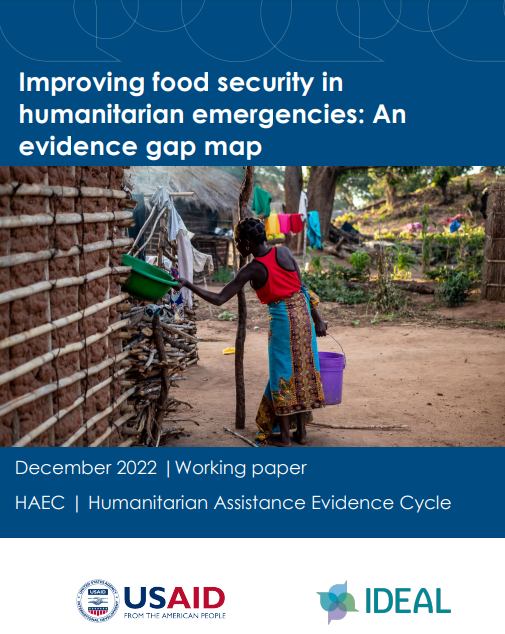
Improving Food Security in Humanitarian Emergencies: An evidence gap map

This report presents the findings of a systematic search to identify and map the evidence base of impact evaluations and systematic reviews of interventions that aim to improve food security during humanitarian crises. The findings from this EGM provide a basis for policymakers to consult rigorous evidence in the formulation of programming. Researchers are able to use the findings to understand where gaps in evidence currently exist with the opportunity to ensure future work contributes to filling these gaps and avoids duplication.
Download PDF
Improving_food%20security_in_humanitarian_emergencies_An_evidence_gap_map_HAEC_0.pdf

Source: USAID
Year: 2022

Cate Urban

I founded Urban Web Renovations after 11 years of leading global marketing strategies for nonprofit organizations in Washington, DC. In each position I held, one thing remained the same – my passion for managing web sites and social media accounts for both organizations and major thought leaders.

Previous
Previous

Shifting the Locus of Learning: Catalyzing Private Sector Learning to Drive Systemic Change

Next
Next

USAID Report to Congress on Programs in Forestry and the Conservation of Biodiversity during Fiscal Year 2020: Results and Funding