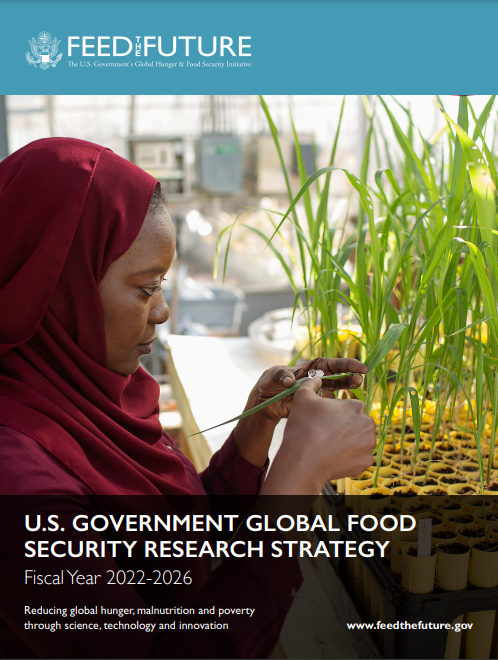
U.S. Government Global Food Security Research Strategy, FY22-26
Agricultural research plays a significant and often underappreciated role in driving economic growth and incomes. This research enables agricultural productivity gains and reduces risks in ways that not only increase overall agricultural production to meet the needs of a growing global population but also are highly effective in reducing poverty and, in turn, contribute to improved food security and nutrition. Research is also critical to successful engagement with the complex systems where climate adaptation and mitigation, inclusive development, and nutrition gains must occur. Demand-led agricultural research can simultaneously address human (e.g., poverty reduction, food security, nutrition) and environmental goals, and historically, agricultural research investments have produced a seven- to tenfold rate of return.
The U.S. Government and its partners provide global leadership in the multiple disciplines required for research that transcends traditional boundaries, integrating scientific disciplines, knowledge, methods and expertise to form novel frameworks to catalyze scientific discovery and innovation to enable convergence research. Prioritizing investments in climate-smart agricultural innovation is an urgent application of this approach that fosters knowledge and technologies that simultaneously enable the world to meet nutritional needs, increase agricultural productivity, reduce food loss and waste, improve livelihoods, conserve nature and biodiversity, build resilience to climate change, reduce future greenhouse gas (GHG) emissions, and sequester carbon.
This Global Food Security Research Strategy outlines the U.S. Government’s science-based, convergent, demand-led, and inclusive approach to addressing food-security challenges, which will continue to span biophysical, socioeconomic and behavioral sciences. In addition to collaboration among U.S. Government agencies, the strategy emphasizes key partnerships with U.S. universities, including minority-serving institutions (MSIs) and those engaged with Feed the Future Innovation Labs; U.S. and international private business and nonprofit sectors; international agricultural research centers; and national research and extension systems in target countries—including government, universities, civil society and private-sector partners.
Source: USAID
Year: 2022