
-
Article
Brief
Meeting Notes
Presentation
Poster
Report
Toolkit
Video
Webinar
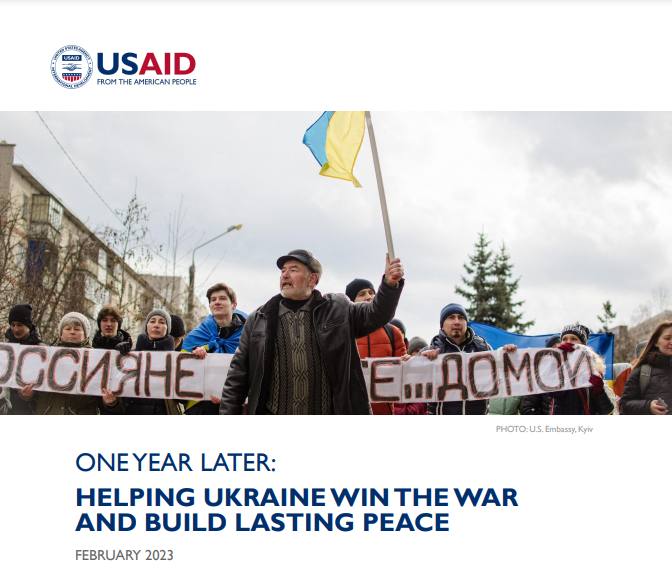
One Year Later: Helping Ukraine Win the War and Build Lasting Peace
To help meet Ukraine’s wartime needs and lay the foundation for a successful recovery, USAID has provided $13 billion in direct budget support, helping the Government of Ukraine (GoU) fund basic public services like healthcare, education, and emergency response; $1.4 billion in humanitarian assistance to save lives and meet the urgent needs of the Ukrainian people; and over $800 million in development assistance to bolster Ukraine’s energy grid, governance institutions, agriculture, small businesses, and civil society in wartime, while also remaining focused on what will be needed for recovery and reconstruction.
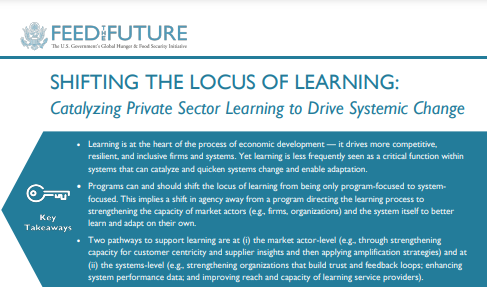
Shifting the Locus of Learning: Catalyzing Private Sector Learning to Drive Systemic Change
This brief makes the case that to stimulate systemic change, economic development programs can and should focus on facilitating stronger learning processes within local actors (e.g., firms, other organizations, government, and civil society) and systems (e.g., sectors, local economy).
USAID Report to Congress on Programs in Forestry and the Conservation of Biodiversity during Fiscal Year 2020: Results and Funding
By conserving coral reefs and mangroves, improving forest management, and driving innovative technologies, USAID’s conservation activities reduce greenhouse gas emissions and increase carbon storage.
Feed the Future Innovation Lab for Food Safety FY2023 Annual Report
In 2022 we made considerable progress on our 29 awarded projects across 12 countries. These projects include impact evaluations of active development programs as well as research that tests new approaches for strengthening food security and resilience. These include a new project that builds a technical definition and measure of resilience in the context of poverty traps and the true complexities facing rural households. These also include two seed grants that have been awarded full funding, one in Ethiopia and one in Ghana, both of which are testing innovations in agricultural index insurance. We reported results from two projects providing insights on how livelihood-building programs for women can generate resilience to hardships that include drought and the COVID-19 pandemic.
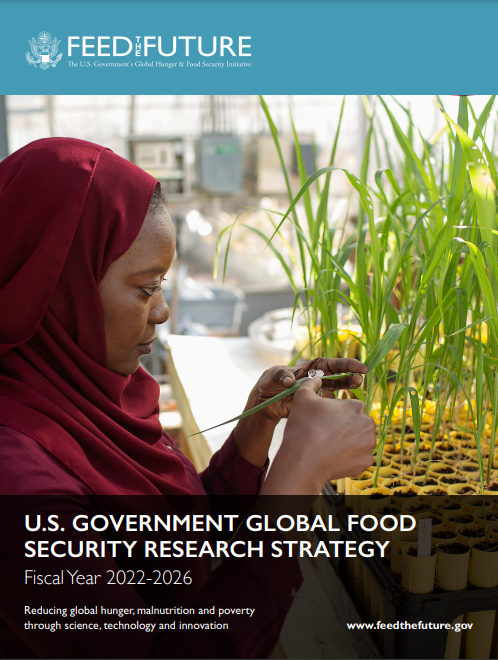
U.S. Government Global Food Security Research Strategy, FY22-26
This Global Food Security Research Strategy outlines the U.S. Government’s science-based, convergent, demand-led, and inclusive approach to addressing food-security challenges.
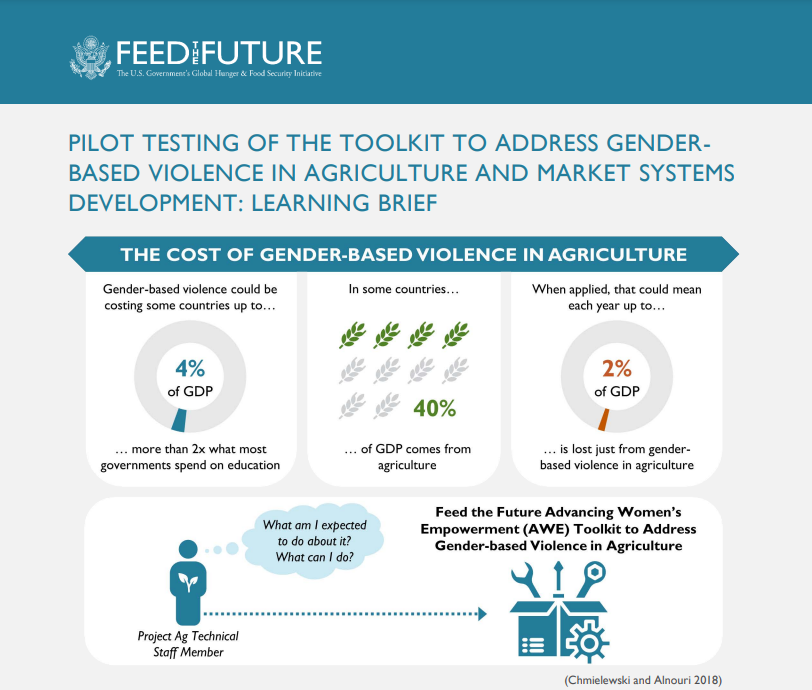
Pilot Testing of the Toolkit To Address Gender-Based Violence in Agriculture and Market Systems Development
There are both strong moral and ethical reasons and a compelling business case for addressing GBV in the private sector, which are strongly interlinked: GBV not only negatively affects the health and well-being of those who experience it, it also reduces agricultural productivity, workplace and worker productivity, and workforce readiness, as well as market competitiveness, stability, and resilience.
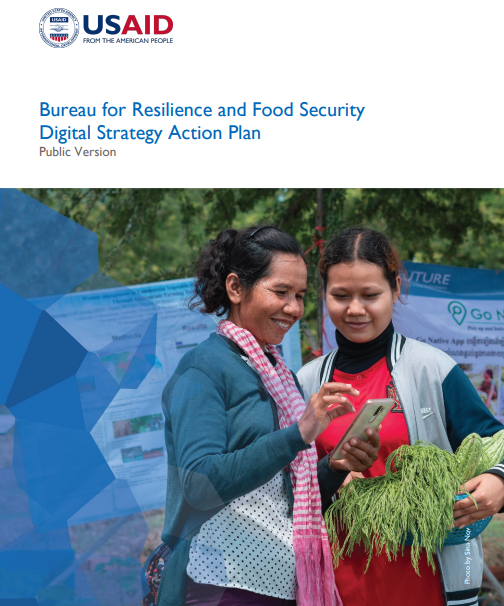
Bureau for Resilience and Food Security Digital Strategy Action Plan
To work toward this vision, RFS aims to use digital technologies effectively to create more inclusive, efficient, prosperous, healthy, and connected agriculture, food, and water systems today — and more climate-smart and resilient agriculture, food, and water systems for tomorrow that sustainably support the health, well-being, and livelihoods of our target populations.

2021 Climate Readiness Plan
With this new Climate Readiness Plan (CRP), USAID is revitalizing its approach to climate change adaptation, resilience, and risk mitigation across the Agency’s programs and operations and is also committing to ambitious mitigation targets and new adaptation actions in alignment with Biden-Harris Administration priorities, multilateral climate objectives, and the newest climate science.
Feed the Future Innovation Lab for Markets, Risk & Resilience 2020 Annual Report
The Feed the Future Innovation Lab for Markets, Risk & Resilience at UC Davis has the increasing importance of resilience at all levels, from systems to individual families, at the very center of its research program. Launched in July in 2019 by USAID, the lab builds upon a foundation of field studies and theoretical work to help families and communities build resilience to perennial threats like drought but also against unforeseen shocks like the COVID-19 pandemic. We are also testing how resilience itself can generate additional returns through a well-established phenomenon we call Resilience+.
Key Lessons From Private Sector Engagement in the USAID Learning Community for Supply Chain Resilience
Any partnership between a company, NGO or research institution can be fraught with misalignment of stated objectives, appetite for risk, and short- versus long-term thinking.
An Introduction to Assessing Climate Resilience in Smallholder Supply Chains
For companies sourcing from smallholders, evaluating resilience to climate change poses particular challenges. Smallholder sourcing entails working with many, diverse farmer communities around the globe, each with its own agricultural practices, cultural context, and risk exposure.
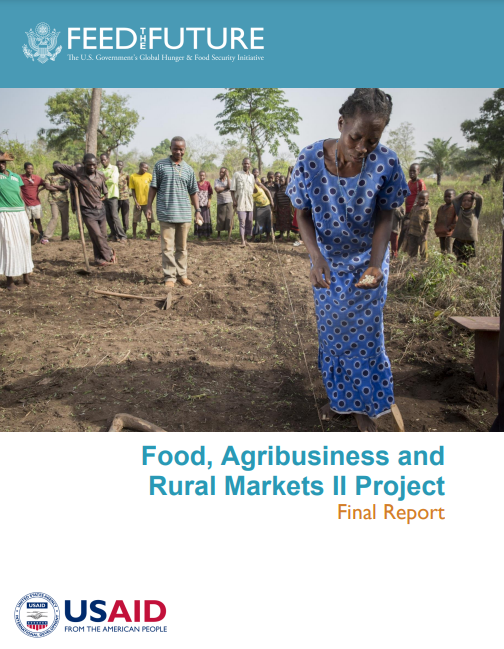
Food, Agribusiness and Rural Markets II Project
FARM II’s yield assessments showed that productivity yields of beneficiary farmers were 29 percent higher than those of non-beneficiary farmers. Greenbelt farmers also significantly exceeded African continent averages for all four assessed crops. The study suggested that the improved technologies and farming practices introduced by FARM II are taking hold among nonbeneficiary farmers in the region. Here, Betty Abou from Magwi County in Eastern Equatoria State packs maize to be taken to Juba for sale.