
-
Article
Brief
Meeting Notes
Presentation
Poster
Report
Toolkit
Video
Webinar
Climate Change Social Media Links They Forgot to Delete
While the Climatelinks website was removed, no one deleted the related social media accounts. Check them out before they go away!
USAID Accelerating Resilience and Transformation Activity — Bangladesh
USAID Accelerating Resilience and Transformation Activity aims to transform key systems in Bangladesh’s agriculture, energy, and disaster risk management sectors and shift market signals that result in climate resilient, net-zero outcomes. This approach is centered on principles of gender equality, social inclusion of historically marginalized groups and the self-empowerment of women and youth, all of which are critical to achieving sustainable low carbon and climate-resilient development. Localized activities will be designed and implemented in partnership with Bangladeshi civil society and the private sector and include the use of strategic grants to catalyze locally led change, build capacity, and amplify impact.
Climate Change Country Profiles 2023-2024
Snapshots of USAID goals, projects and outcomes around the globe
Climate Fragility Programming Resource Guide
The purpose of this resource guide is to support those working on conflict prevention and stabilization to 1) have a better understanding of the risks climate change poses to their work; 2) be equipped with the tools and approaches to best integrate climate change into existing or future programming; and 3) ultimately ensure that their conflict prevention and stabilization work has positive and sustainable outcomes.
New Measures of Success for Climate Adaptation and Resilience
Today there is no alignment among investors, governments, donors, and other stakeholders on how to quantify the benefits of A&R investments. This is holding back much-needed private-sector investment and limiting progress on the implementation of national climate plans. Today there is no alignment among investors, governments, donors, and other stakeholders on how to quantify the benefits of A&R investments. This is holding back much-needed private-sector investment and limiting progress on the implementation of national climate plans.
USAID Resilience Policy 2024
As an update to USAID’s inaugural resilience policy (2012), this policy reiterates the goal of reducing humanitarian need in areas of recurrent crisis while also reinforcing resilience as an Agency priority across all USAID programming.
How USAID Prepares for Hurricane Season
Just one major hurricane can be devastating. That’s why USAID – through its Bureau for Humanitarian Assistance – prepares year-round to help communities in Latin America and the Caribbean prepare for the Atlantic hurricane season.
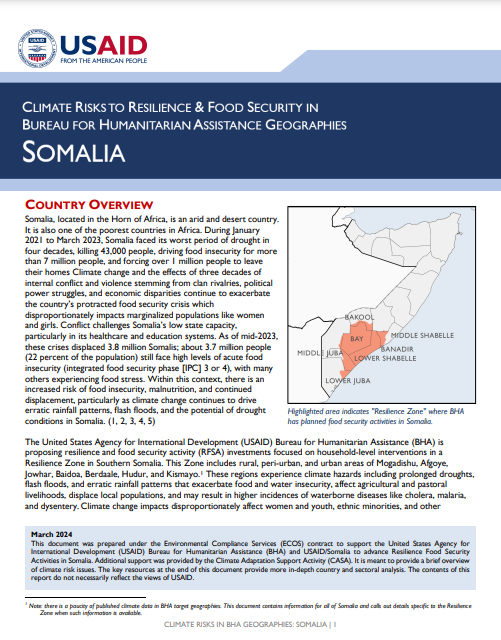
Climate risks to resilience and food security in Bureau for Humanitarian Assistance Geographies: Somalia
The United States Agency for International Development (USAID) Bureau for Humanitarian Assistance (BHA) is proposing resilience and food security activity (RFSA) investments focused on household-level interventions in a Resilience Zone in Southern Somalia.
USAID Climate Ready Final Report
USAID Climate Ready, implemented by DT Global, was USAID’s flagship project designed to address climate change adaptation priorities in the Pacific.
FY2023 Annual Report Feed the Future Innovation Lab for Food Safety
In FY2023, the Feed the Future Innovation Lab for Food Safety (FSIL) subaward projects in Bangladesh, Cambodia, Kenya, Nepal, Nigeria, and Senegal made significant progress in data collection to better understand microbial food safety challenges in each focus country, analyze the roles and opportunities for women in food safety and in different food value chains, and identify appropriate food safety interventions. All projects entered their final year of activities (year three for long-term subawards in Bangladesh, Cambodia, Kenya, and Senegal and year two for short-term subawards in Nepal and Nigeria) and many have started to analyze data and disseminate results. In FY2023, FSIL subaward projects published nine peer-reviewed journal articles, gave seven conference presentations, and hosted workshops and training sessions for producers, extension agents, government stakeholders, and the private sector.
Carbon Finance Playbook
Demystifying the capital raising process for Nature-based Carbon Projects in Emerging Markets

USAID Climate Ready: Adaptation and Finance for Impact
Following COP21 in December 2015—which also brought about the Paris Agreement— Conference attendees committed to addressing climate change using substantial financing through international donors and funds. As part of this movement, the USAID launched the USAID Climate Ready Project.
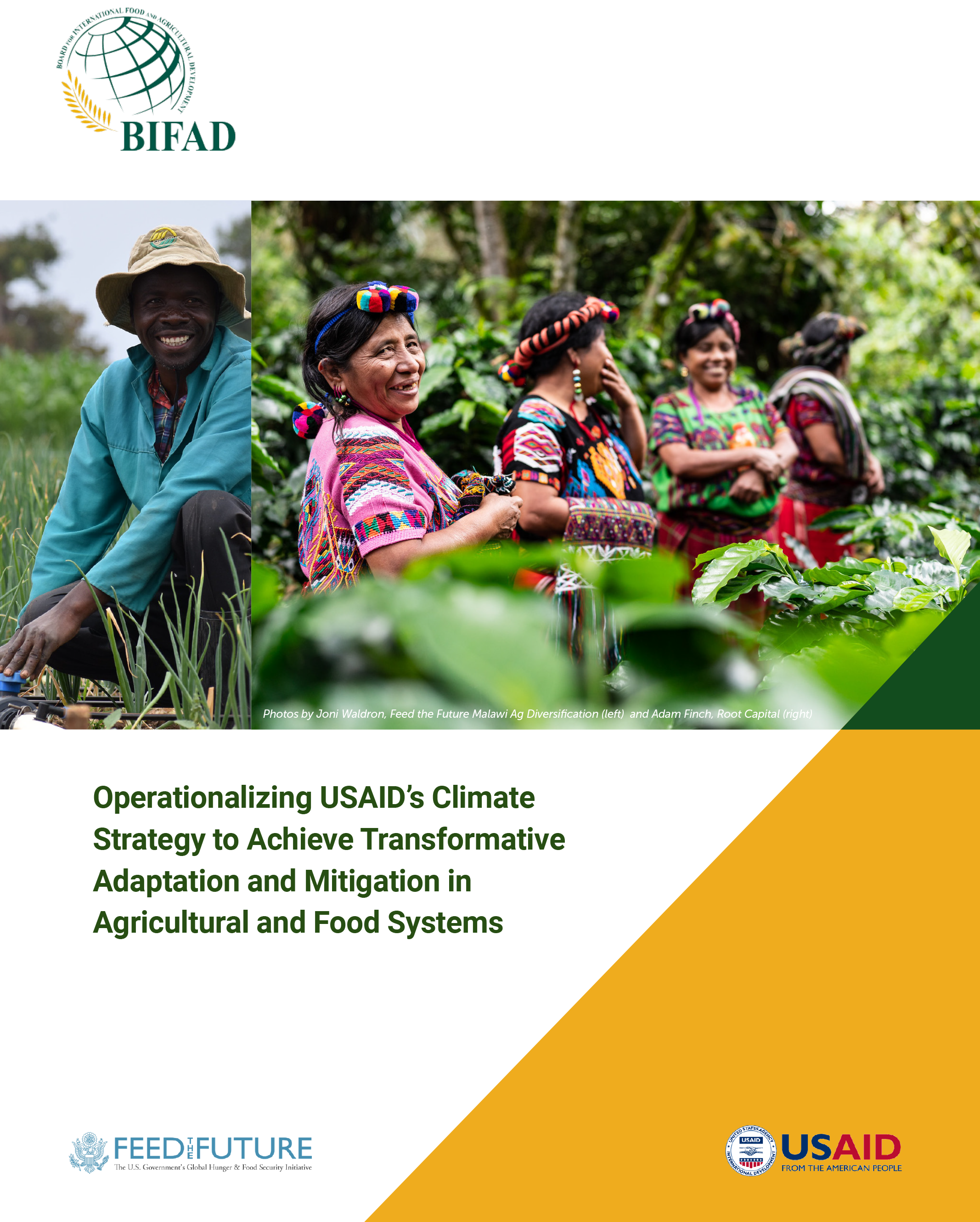
Operationalizing USAID’s Climate Strategy to Achieve Transformative Adaptation and Mitigation in Agricultural and Food Systems
The U.S. Agency for International Development’s (USAID’s) 2023–2030 Climate Strategy (Climate Strategy) provides a bold and ambitious vision to reduce global greenhouse gas emissions and build resilience to climate change.
Feed the Future Climate Resilient Cereals Innovation Lab (CRCIL)
The MEL Plan is designed based on the CRCIL’s goals, and expected outputs, outcomes, and impacts, taking into consideration the corresponding MEL activities required to assess progress in its achievements. It establishes a sustainable system for ensuring the quality and validity of data by employing rigorous procedures towards the adaptive management necessary to quantify the progress and impact of proposed activities and measure program contributions to the overall program goal. The MEL Plan Collaborating, Learning, and Adapting (CLA) approach, based on the United States Agency for International Development’s (USAID) CLA approach, and CRCIL’s Theory of Change (TOC) will guide the refinement of activity design as needed, based on new evidence, continual learning, and complexity-aware monitoring and innovative evaluation activities.
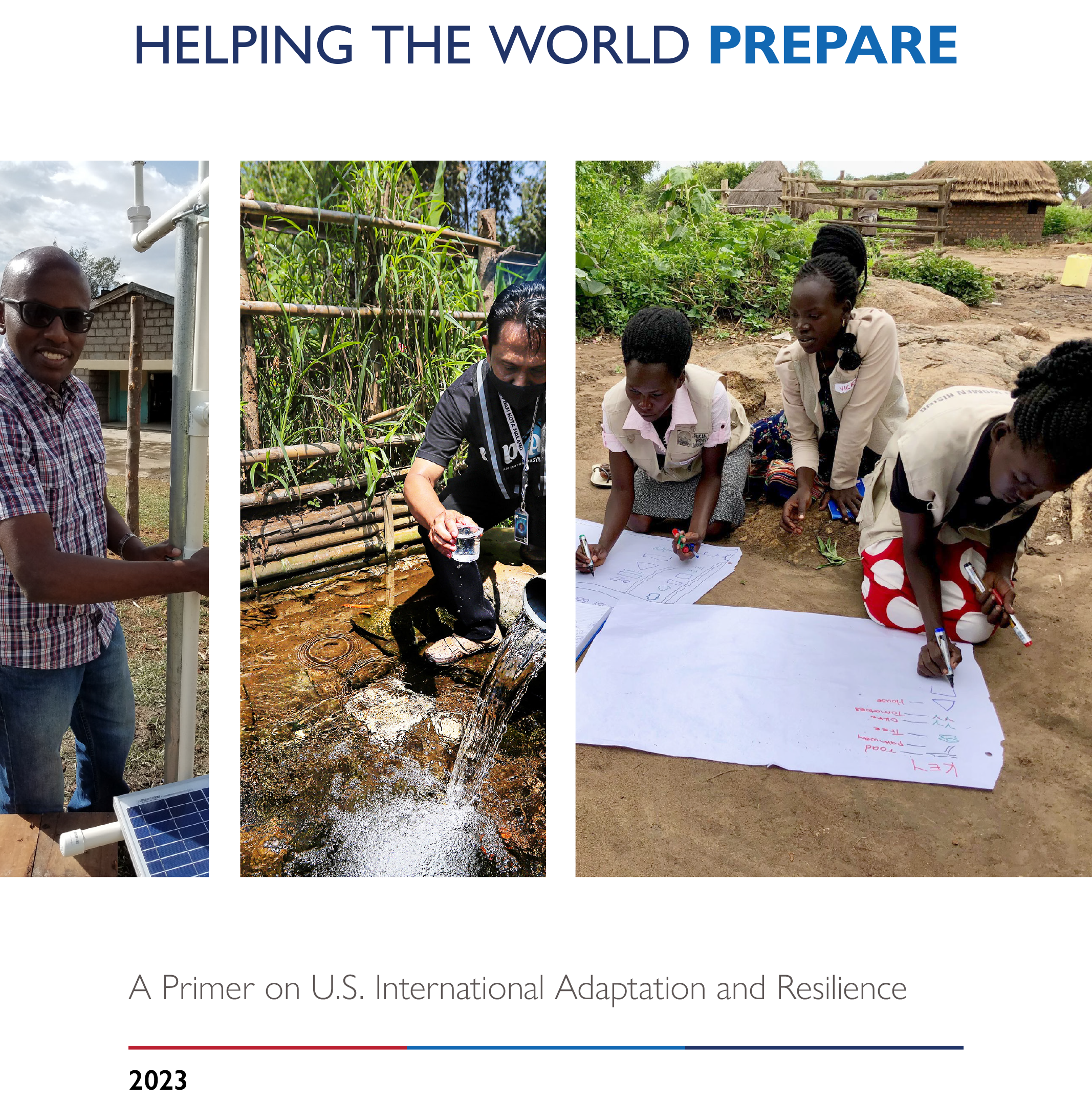
Helping the World Prepare: A Primer on U.S. International Adaptation and Resilience
The climate crisis is existential, and the impacts of climate change that are being felt around the world threaten to undermine development gains, exacerbate geopolitical tensions, accelerate the food security crisis, and result in greater instability and humanitarian need.
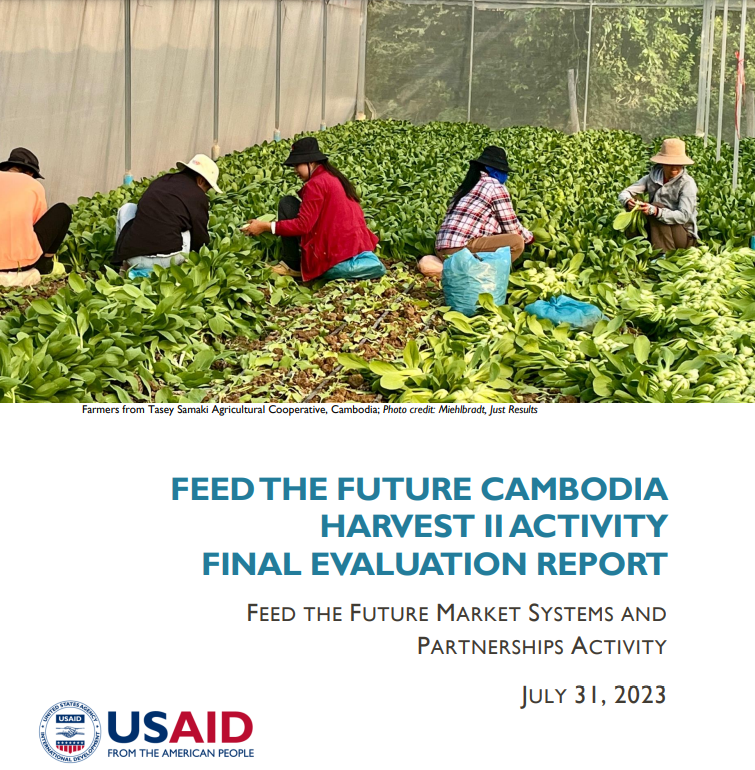
Feed the Future Cambodia Harvest II Activity Final Evaluation Report
This report presents the findings from the final evaluation of the Feed the Future Cambodia Harvest II activity (Harvest II) funded by the United States Agency for International Development (USAID) and operating from 2017-2022. The approach taken by Harvest II represented a shift in emphasis from previous USAID-funded activities that offered support to agricultural production, moving intentionally towards a demand-driven, market systems development approach. The evaluation team was asked to assess the extent and nature of system change that resulted from the activity, and how farms and firms benefited. The team also assessed whether and how the project contributed to resilience, climate change mitigation, and environmental stewardship.
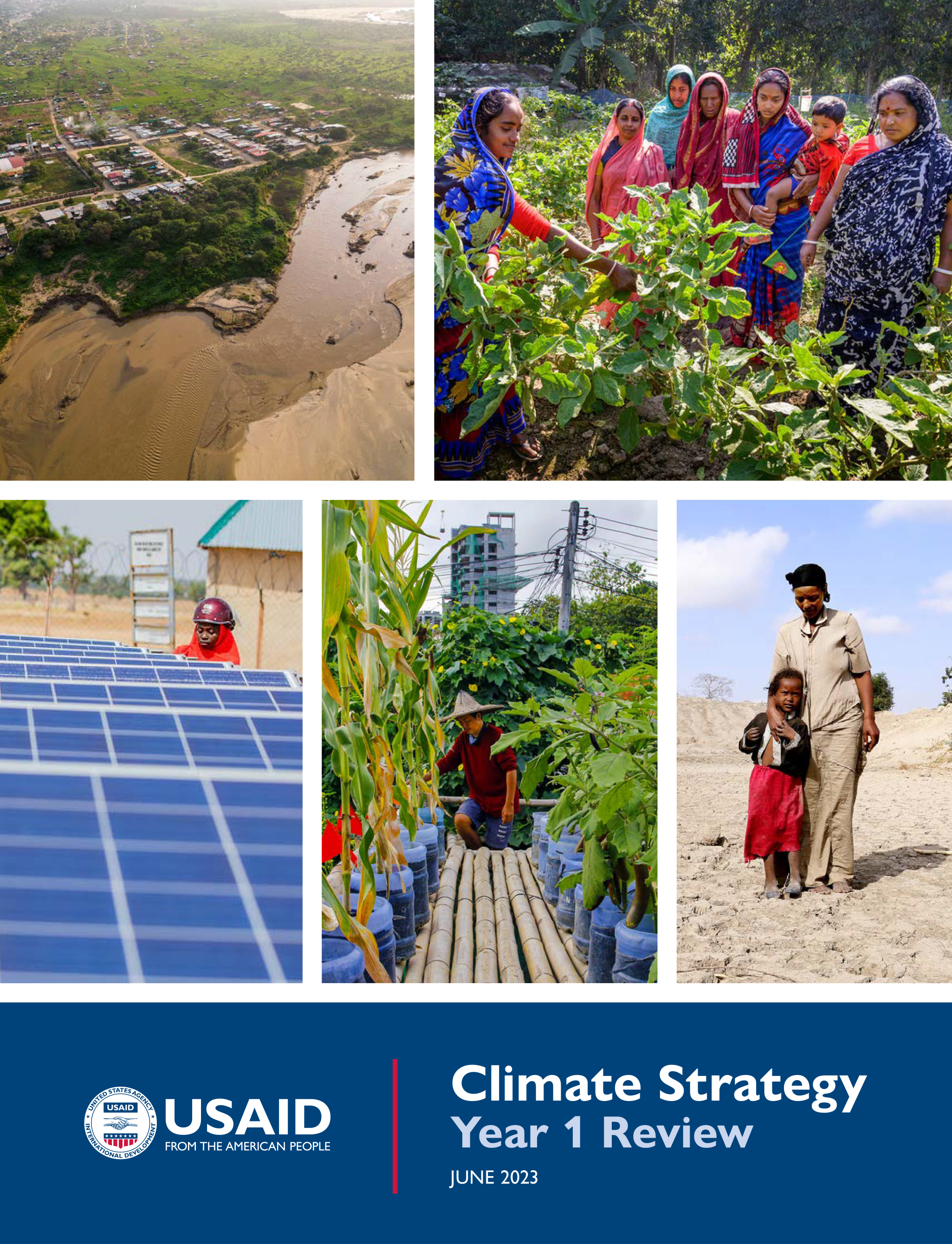
Climate Strategy Year 1 Review
Over the past year, USAID has launched a wide variety of initiatives, partnerships, and internal and interagency processes to implement the Strategy and set the foundation for achieving the goals over the eight years of the Strategy timeline.
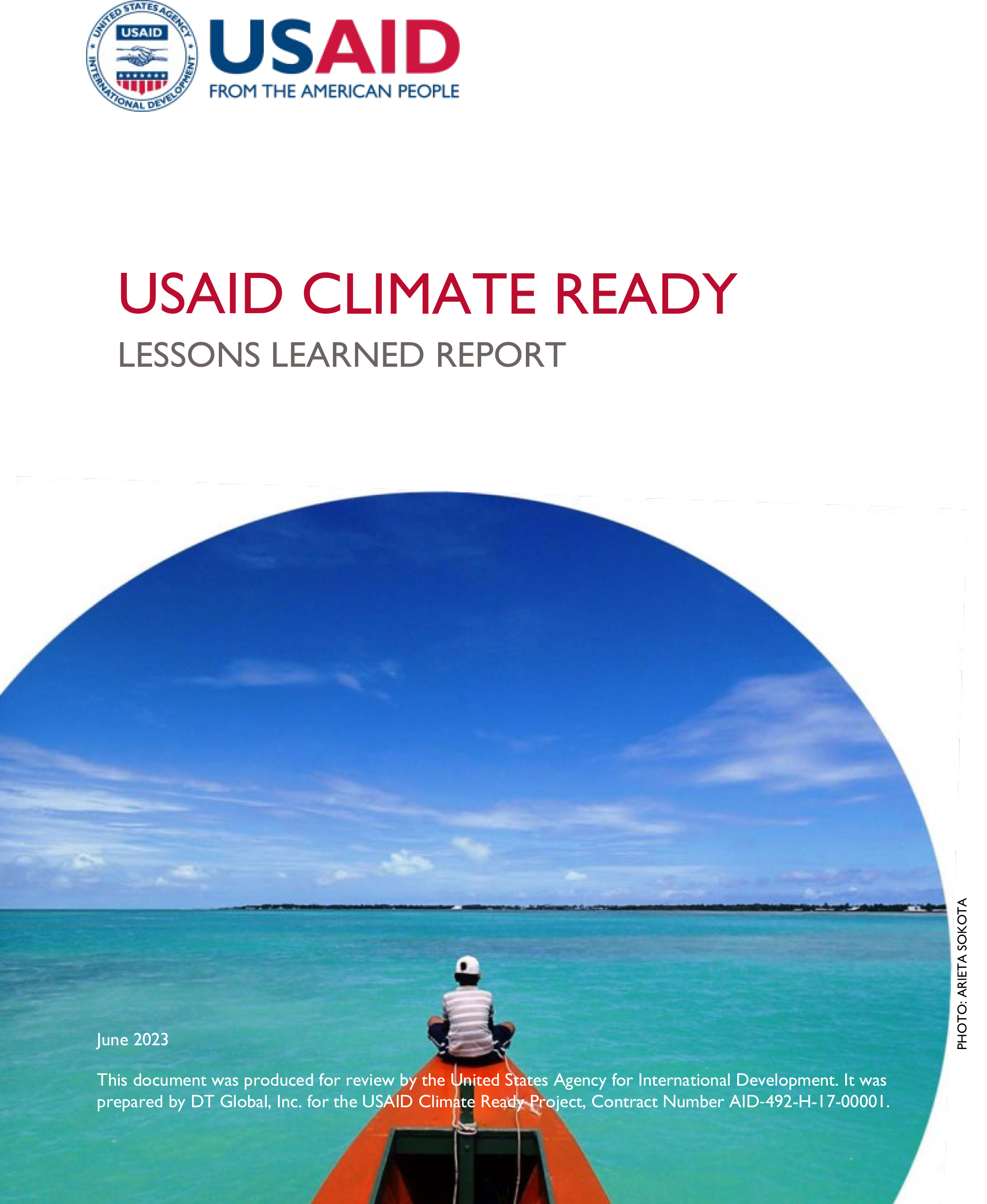
USAID Climate Ready Lessons Learned Report
USAID Climate Ready is focused on achieving its Strategic Objective of capacity of PICs increased to adapt to negative impacts of climate change.