Climate risks to resilience and food security in Bureau for Humanitarian Assistance Geographies: Somalia
Somalia, located in the Horn of Africa, is an arid and desert country. It is also one of the poorest countries in Africa. During January 2021 to March 2023, Somalia faced its worst period of drought in four decades, killing 43,000 people, driving food insecurity for more than 7 million people, and forcing over 1 million people to leave their homes Climate change and the effects of three decades of internal conflict and violence stemming from clan rivalries, political power struggles, and economic disparities continue to exacerbate the country’s protracted food security crisis which disproportionately impacts marginalized populations like women and girls. Conflict challenges Somalia’s low state capacity, particularly in its healthcare and education systems. As of mid-2023, these crises displaced 3.8 million Somalis; about 3.7 million people (22 percent of the population) still face high levels of acute food insecurity (integrated food security phase, with many others experiencing food stress. Within this context, there is an increased risk of food insecurity, malnutrition, and continued displacement, particularly as climate change continues to drive erratic rainfall patterns, flash floods, and the potential of drought conditions in Somalia.
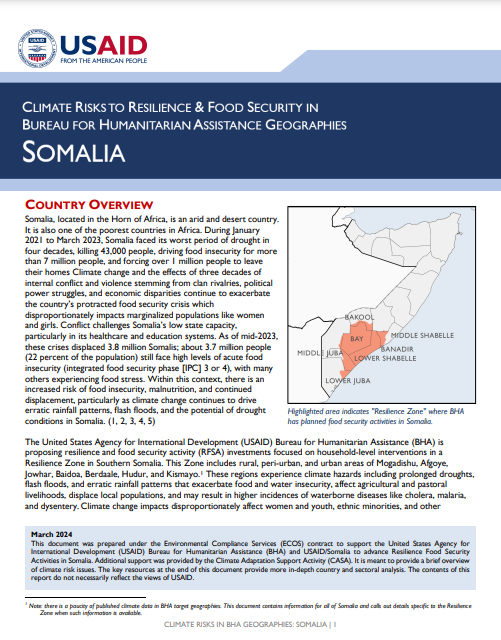
The United States Agency for International Development (USAID) Bureau for Humanitarian Assistance (BHA) is proposing resilience and food security activity (RFSA) investments focused on household-level interventions in a Resilience Zone in Southern Somalia. This Zone includes rural, peri-urban, and urban areas of Mogadishu, Afgoye, Jowhar, Baidoa, Berdaale, Hudur, and Kismayo. These regions experience climate hazards including prolonged droughts, flash floods, and erratic rainfall patterns that exacerbate food and water insecurity, affect agricultural and pastoral livelihoods, displace local populations, and may result in higher incidences of waterborne diseases like cholera, malaria, and dysentery. Climate change impacts disproportionately affect women and youth, ethnic minorities, and other
Source: USAID
Year: 2024