Task Sharing Tubal Ligation Services with Health Officers in Ethiopia
The private health sector can affect policy change related to task sharing by demonstrating that the approach is successful in a clinical setting. Research reveals that health officers can safely offer tubal ligation services, with high acceptability among clients.
Voluntary long-acting reversible contraception (LARC) methods and permanent methods are important family planning options. However, in many developing countries, a shortage of trained health providers presents a barrier to accessing these methods. Task sharing LARC and permanent method services with mid-level clinical providers can increase family planning access and choice.
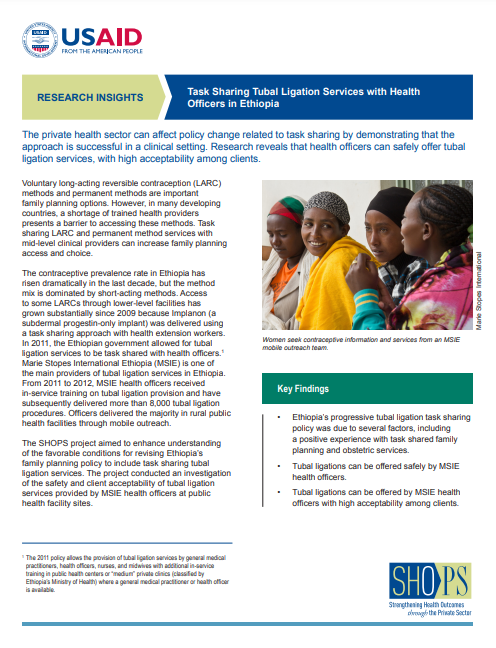
The contraceptive prevalence rate in Ethiopia has risen dramatically in the last decade, but the method mix is dominated by short-acting methods. Access to some LARCs through lower-level facilities has grown substantially since 2009 because Implanon (a subdermal progestin-only implant) was delivered using a task sharing approach with health extension workers. In 2011, the Ethiopian government allowed for tubal ligation services to be task shared with health officers.1 Marie Stopes International Ethiopia (MSIE) is one of the main providers of tubal ligation services in Ethiopia. From 2011 to 2012, MSIE health officers received in-service training on tubal ligation provision and have subsequently delivered more than 8,000 tubal ligation procedures. Officers delivered the majority in rural public health facilities through mobile outreach.
The SHOPS project aimed to enhance understanding of the favorable conditions for revising Ethiopia’s family planning policy to include task sharing tubal ligation services. The project conducted an investigation of the safety and client acceptability of tubal ligation services provided by MSIE health officers at public health facility sites.
Source: USAID
Year: 2015