
-
Article
Brief
Meeting Notes
Presentation
Poster
Report
Toolkit
Video
Webinar
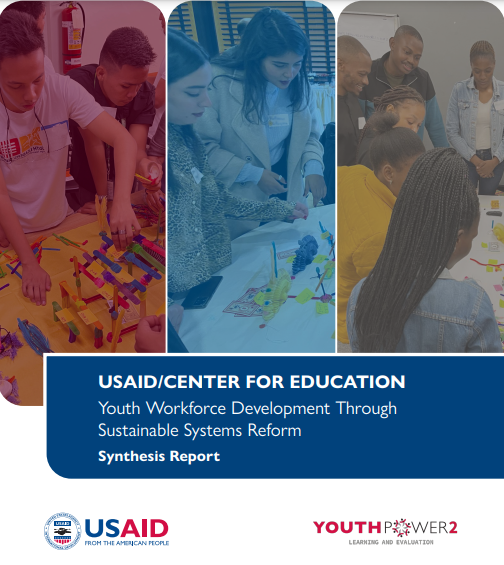
Youth Workforce Development Through Sustainable Systems Report
The United States Agency for International Development (USAID) seeks to increase its understanding of effective approaches for supporting improved, scaled, and sustainable youth workforce development (YWFD) outcomes in low- and middle-income countries (LMICs). USAID commissioned the Better Youth Workforce Development Outcomes Through Sustainable Systems Reform buy-in activity through its YouthPower2: Learning and Evaluation (YP2LE) Activity implemented by Making Cents International.
Ukrainian Youth Opinion Survey, Wave 3
The survey was conducted on behalf of the International Republican Institute’s Center for Insights in Survey Research (CISR) within the scope of the Ukraine National Identity through Youth (UNITY) program in collaboration with the International Research and Exchanges Board (IREX). The field work was conducted by Info Sapiens.
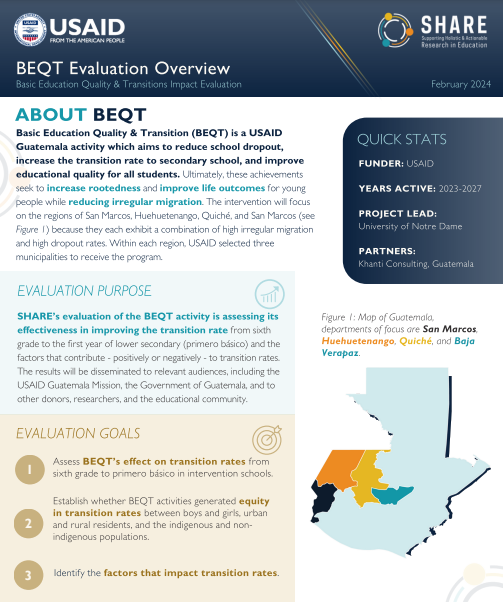
BEQT Evaluation Overview: Basic Education Quality & Transitions Impact Evaluation
Basic Education Quality & Transition (BEQT) is a USAID Guatemala activity which aims to reduce school dropout, increase the transition rate to secondary school, and improve educational quality for all students. Ultimately, these achievements seek to increase rootedness and improve life outcomes for young people while reducing irregular migration. The intervention will focus on the regions of San Marcos, Huehuetenango, Quiché, and San Marcos because they each exhibit a combination of high irregular migration and high dropout rates. Within each region, USAID selected three municipalities to receive the program.
LITES Study Overview: Language of Instruction Transition in Education Systems
LITES is a cross-country study (occurring in Kenya, Mali, Mozambique, the Philippines, Senegal, and Rwanda) seeking to fill this this knowledge gap by generating empirical evidence regarding factors that contribute to the success of language of instruction transitions for learners’ second language literacy skills. Evidence generated from this study will provide useful insights to bilingual and multilingual education in low-resource settings.
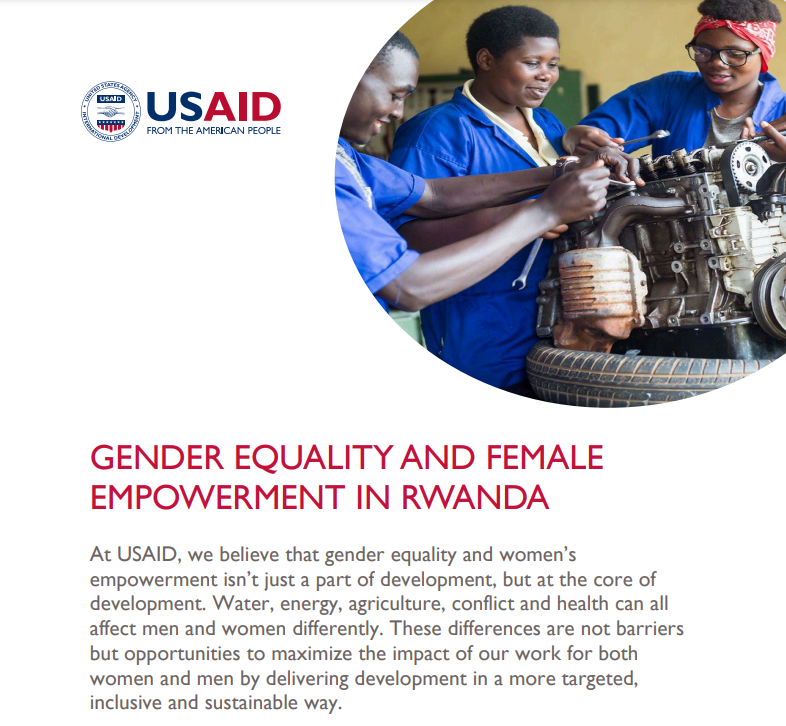
Gender Equality and Women's Empowerment in Rwanda
Rwanda is recognized as a leader in gender equality and women’s empowerment. Women hold positions making up 61 percent of the Rwandan Parliament, and 50 percent of the President’s cabinet. While these efforts are so important, challenges still remain, specifically when it comes to achieving socio-economic equality and cultural change at the community level.
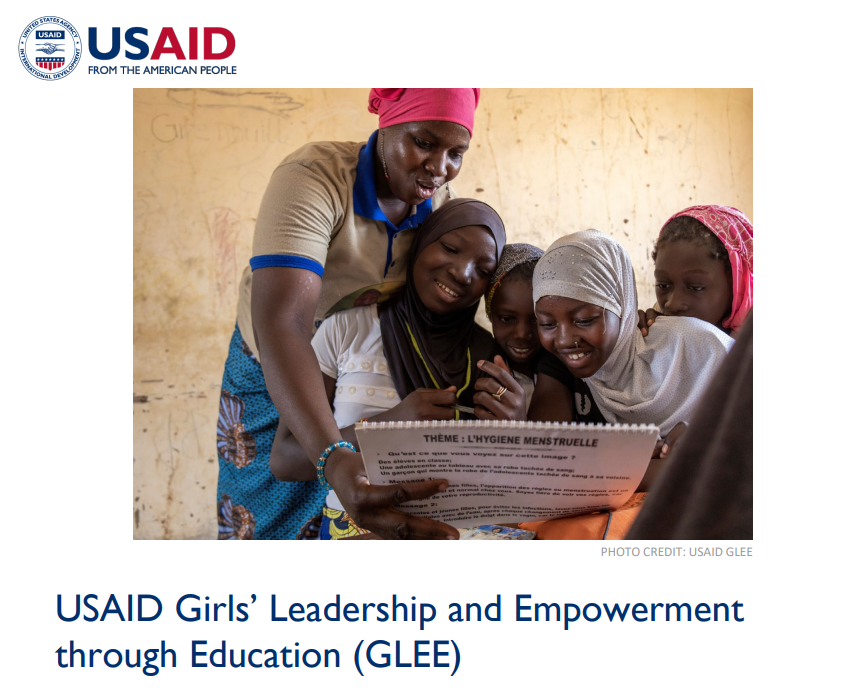
Girls' Leadership and Empowerment Through Education (GLEE)
In line with USAID’s Education Policy, USAID Girls’ Leadership and Empowerment through Education (GLEE) decreases barriers to quality education in a safe and supportive learning environment for adolescent girls (10-18 years) while increasing the adoption of positive, healthy behaviors. USAID GLEE trains teachers to improve children’s learning, school management committees to improve transparency and accountability, and parents and community members to support girls’ access to learning.
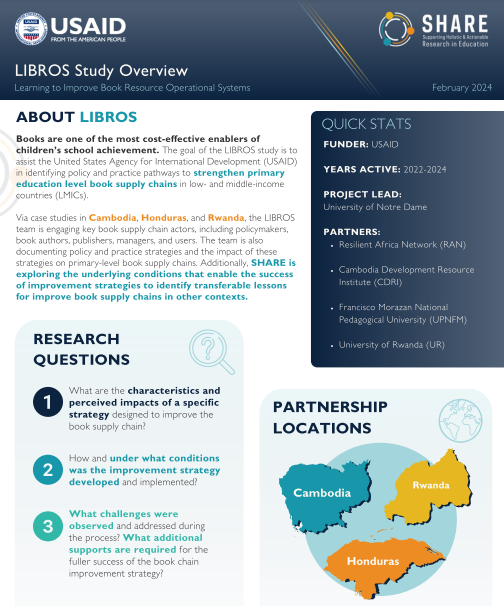
LIBROS Study Overview Learning to Improve Book Resource Operational Systems
Via case studies in Cambodia, Honduras, and Rwanda, the LIBROS team is engaging key book supply chain actors, including policymakers, book authors, publishers, managers, and users. The team is also documenting policy and practice strategies and the impact of these strategies on primary-level book supply chains.
Review of Disability Inclusive Education in USAID Asia Education Programming
This report presents findings from both a desk review (consisting of a review of activity documentation and surveys of USAID Missions and ongoing activities) of 26 basic education activities across 11 countries in Asia and three case studies conducted in Tajikistan, the Philippines, and Bangladesh. The primary objective of the case studies was to gain a better understanding of the collaboration on disability-inclusive education between USAID Missions, host governments, implementing partners, and other educational stakeholders within each country. Furthermore, the case studies provided an opportunity to explore how past basic education activities and education systems within each country have influenced the development and implementation of new basic education activities as they relate to disability inclusion.