-
Article
Brief
Meeting Notes
Presentation
Poster
Report
Toolkit
Video
Webinar
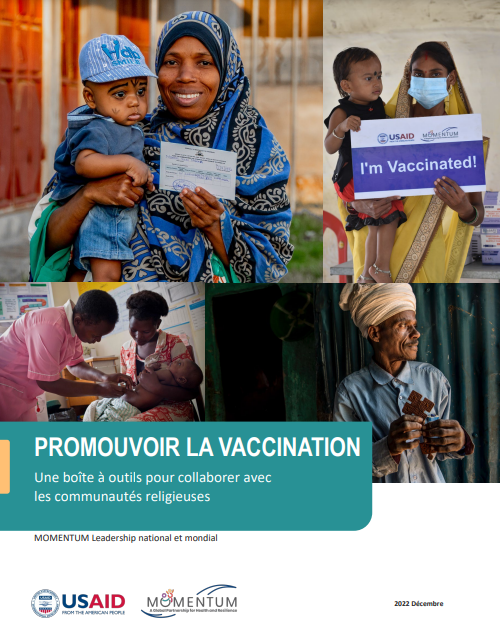
Promoting Vaccination: A Toolkit for Collaborating with Faith Communities (English, French, & Hindi)
This toolkit is designed to equip faith actors and related stakeholders—such as Ministries of Health, medical and scientific bodies, and non-profit organizations that partner with or work alongside faith actors—with the information and tools needed to raise awareness, reduce misinformation, and address barriers that prevent faith communities, in particular, from engaging in vaccination.
Climate Fragility Programming Resource Guide
The purpose of this resource guide is to support those working on conflict prevention and stabilization to 1) have a better understanding of the risks climate change poses to their work; 2) be equipped with the tools and approaches to best integrate climate change into existing or future programming; and 3) ultimately ensure that their conflict prevention and stabilization work has positive and sustainable outcomes.
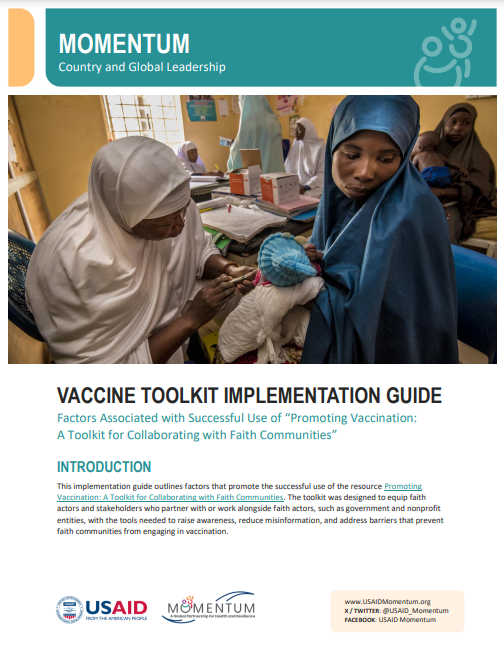
Vaccine Toolkit Implementation Guide (available in Hindi)
The vaccine promotion toolkit was developed as a part of the U.S. Agency for International Development’s MOMENTUM Country and Global Leadership project, which includes an initiative to identify and address concerns among religious leaders and faith-based communities around vaccination.
Maternal Mental Health: A Toolkit for Engaging Faith Actors as Change Agent
Given the high prevalence of mental health conditions in the perinatal period—pregnancy up to two years after birth—global attention to mental health is essential. Communities must work together to support prevention, early detection, and treatment of mental health conditions during pregnancy and postpartum, when the risk of mental disorders is highest.
USAID/BHA Emergency Application Guidelines Sector Requirements
BHA’s Emergency Application Guidelines (EAG) are three core documents, with supplemental guidance and resources provided on the EAG webpage (BHA EAG Page), which is linked at the bottom of every page of this document.
Integrating Complementary Feeding in Emergencies
This decision tool is intended for those involved in the design, planning, implementation, and monitoring of a nutrition humanitarian response before and during an emergency. It aims to guide technical advisors and managers working on a humanitarian response to design and incorporate complementary feeding actions, whether they are implemented by individual organizations and/or by joint multi-agency humanitarian responses, for children 6–23 months of age, regardless of their breastfeeding status, at each stage of the humanitarian program cycle.
Feed the Future and Conflict Integration
This toolkit is a groundbreaking effort to ensure all investments under the United States Government’s Global Food Security Strategy integrate conflict. The better we understand the connections between conflict and food systems, the better we can meet the goals of the Feed the Future Initiative while also contributing to a more peaceful world. Fragility, conflict, and violence (FCV) can easily undermine progress under Feed the Future, but there are steps we can take to mitigate these dynamics and capitalize on opportunities for peace throughout our programming.
Urban Resilience Technical Guidance
USAID can improve development outcomes by strengthening urban resilience. Through this approach USAID can guard against risks and help capture and safeguard the benefits of urbanization, especially for the most vulnerable. Concepts from this technical guidance can be applied to focused sector programming as well as integrated programming across sectors.
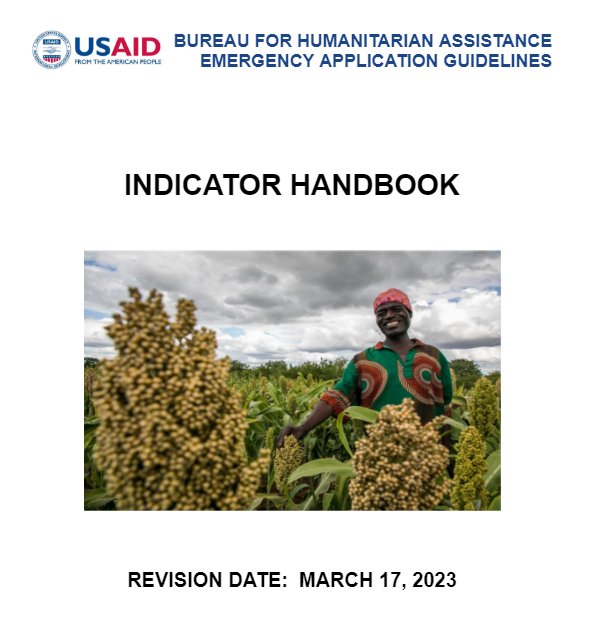
USAID/BHA Emergency Application Guidelines Indicator Handbook
The Indicator Handbook provides the performance indicator reference sheets (PIRS) for BHA emergency indicators. The Handbook provides guidance on applicability criteria for each BHA emergency indicator, and guidance on what you must include in custom indicator PIRSs.
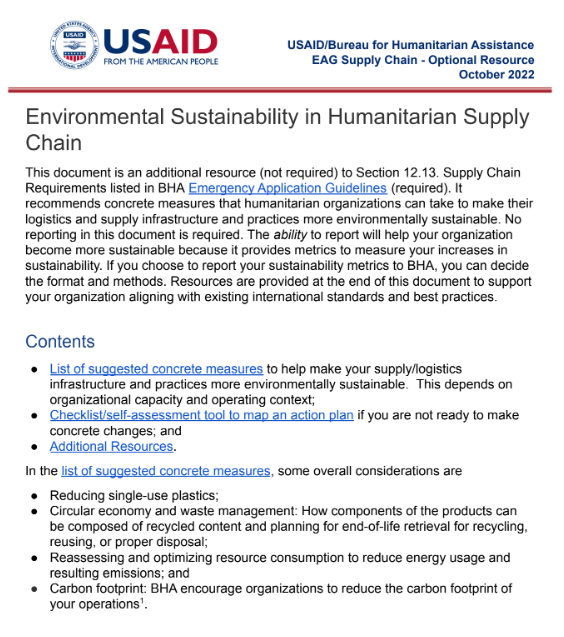
Environmental Sustainability in Humanitarian Supply Chain
This document is an additional resource to Section 12.13. Supply Chain Requirements listed in BHA Emergency Application Guidelines.
Media for Democracy Assessment Tool
How do media connect to democracy and how can media support democracy promotion and civic space?
Toolkit to Address Gender-Based Violence in Agriculture and Market Systems Development
The Toolkit to Address Gender-Based Violence in Agriculture and Market Systems Development seeks to prepare agriculture and MSD project staff to better identify and implement actions to address GBV where it arises in their projects.
Disinformation Primer
This primer presents an overview of disinformation culture to give readers a sense of key concepts, terminology, select case studies, and programmatic design options.
USAID Climate Ready Knowledge Products: Multi-Criteria Analysis Tool
The resultant tool has since been used to assist reviewers to score and prioritize against GCF Investment criteria based on GCF Investment Criteria.
USAID Climate Ready Knowledge Products: Business Continuity Planning Resources
This collection of resources will build your awareness on: The concepts of disaster readiness and business continuity for business; and The key steps for a business to become disaster ready.
How To: Create Digital ID for Inclusive Development
This guide aims to: 1) illustrate how investments in ID systems can both positively and negatively impact individuals and their households, through the illustrative stories of Mary, Joy, and Samuel; and 2) provide specific how to guidance to help donors, program managers, and M&E specialists get started in thinking about ID ecosystems. This guide is specifically targeted towards USAID staff and implementing partners who are providing direct support on ID systems, providing advisory services to government ministries, or are trying to find ways to identify beneficiaries in a project or activity (regardless of the sector).
Updated Program Functionality Matrix for Optimizing Community Health Programs
The USAID Health Care Improvement (HCI) Project developed the CHW AIM Toolkit in 2011 to help organizations assess community health program functionality and improve program performance. As with the original AIM tool, this updated version is intended to capacitate the processes of programmatic design, planning, assessment, and improvement, for stakeholders ranging from local NGOs, to national policymakers and planners, to global stakeholders.
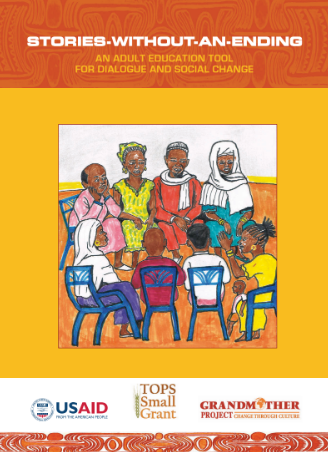
Stories Without an Ending: An Adult Education Tool for Dialogue and Social Change (English & French)
The purpose of this guide is to help organizations involved in community programs to develop and use SWE. This innovative adult education tool can be used to actively engage community groups in discussion of issues of priority concern to them and/or to development programs and to catalyze discussion of those issues in the wider community.
Emergency Supply Chain Playbook: Preparedness Overview Guide
To provide sponsors, senior leadership, and interested partners with an introduction to emergency supply chain preparedness as it is covered in the Playbook.