The Role of the Private Sector in Health
Pre-congress Symposium; the World Congress of the International Health Economics Association (Ihea)
The private sector is playing an increasingly important role in health. Currently, nearly 60% of the total expenditure on health in low- and middle-income countries is private, rising above 80% in countries such as India, Pakistan, Guinea, and the Democratic Republic of Congo. Historically, the private health sector has been neglected in policy making, but information regarding the scale and complexity of the private sector has grown the last decade. Today, it is generally acknowledged that there is a need to improve the research base in this field in order to promote evidence-informed policies.
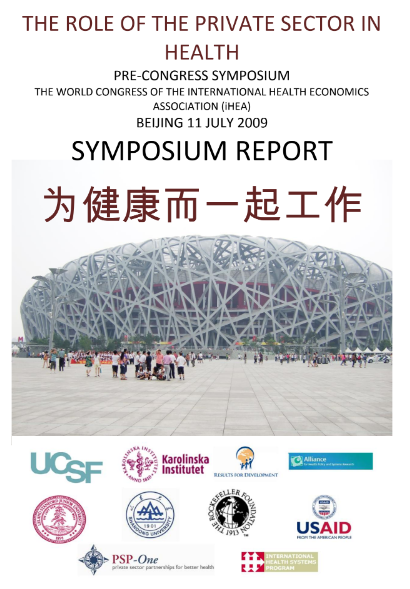
A full-day symposium on the role of the private sector in health was held July 11th 2009 at the Beijing International Convention Centre bringing together health economists, public health experts, policy makers and health care managers specializing in improving health care in low- and middle-income countries. Convened one day before the World Congress of the International Health Economics Association (iHEA), this private sector symposium attracted over a hundred participants from nations around the world.
The program featured sessions with technical presentations covering the following themes: Understanding growing private participation in changing health systems, Understanding the private sector role in service delivery, Models of mixed systems, Working with the private sector and Policy. Further, the program included keynote speakers from the World Bank, Mukesh Chawla, and the Chinese Ministry of Health, Dr. Haichao Lei. A plenary panel session led by Dominic Montagu, the Global Health Group, University of California, San Francisco (UCSF), closed the full-day symposium. The panel discussed the most important aspects of private health care delivery for public health and what governments should do in order to address those issues.
Symposium Goals
The goal of the symposium was to foster the increasingly important dialogue between researchers interested in the private sector and health policy makers. The symposium served as one event of a series1 with the long-term goal of promoting greater research interest and knowledge generation around the private sector to benefit health systems development. Specifically, the symposium aimed to:
Review issues regarding the private sector where the evidence base is strong and where there is some (emerging) consensus about what is known
Identify pressing policy issues concerning the private sector where further evidence is required
Present research on emerging trends and innovations that are in the process of changing the character of the private sector and its relations with government
Identify and develop strategies to address the main challenges in further developing the knowledge base in this area
Source: USAID
Year: 2009