
-
Article
Brief
Meeting Notes
Presentation
Poster
Report
Toolkit
Video
Webinar
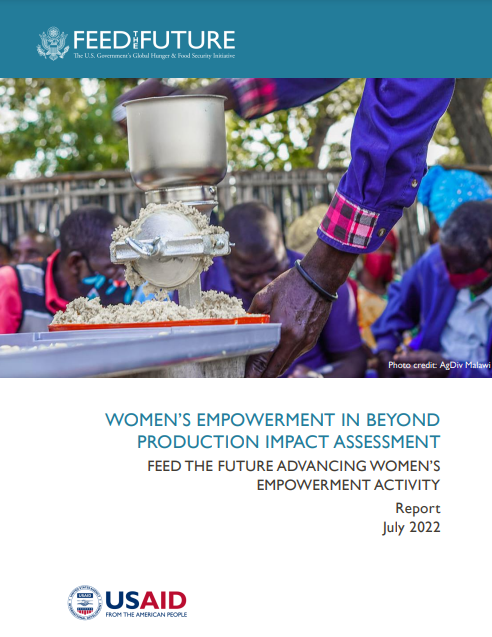
Women’s Empowerment in Beyond Production Impact Assessment
To understand the degree to which AgDiv contributed to those changes and how meaningful the changes were, the AWE team used Feed the Future’s Gender Integration Framework and select measurement guidance from the Project-Level Women’s Empowerment in Agriculture Index for Market Inclusion (PRO-WEAI+MI) survey tool. AWE grouped findings by the WEAI’s five domains: decisionmaking, access to control over resources, control over income, time use, and leadership and social capital.
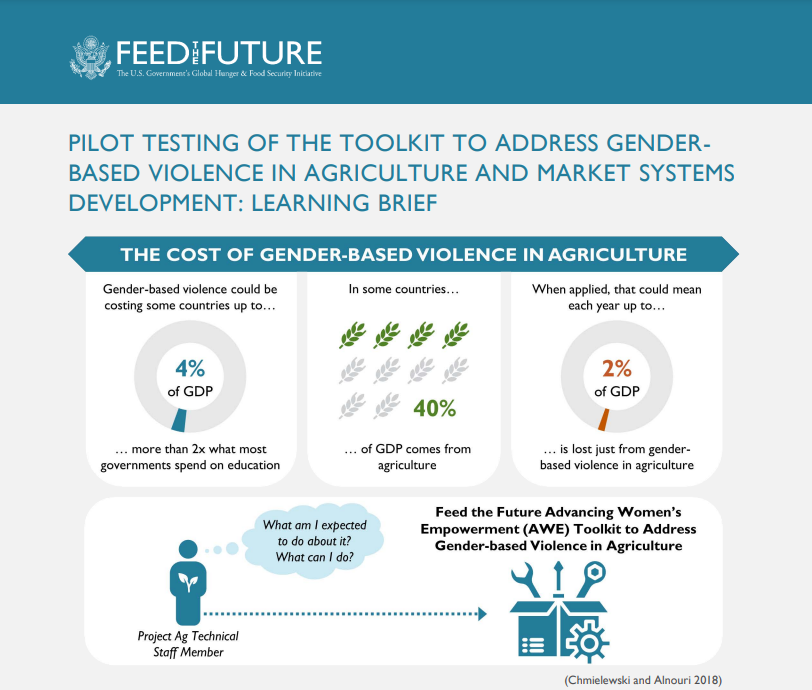
Pilot Testing of the Toolkit To Address Gender-Based Violence in Agriculture and Market Systems Development
There are both strong moral and ethical reasons and a compelling business case for addressing GBV in the private sector, which are strongly interlinked: GBV not only negatively affects the health and well-being of those who experience it, it also reduces agricultural productivity, workplace and worker productivity, and workforce readiness, as well as market competitiveness, stability, and resilience.
U.S. Dept. of State and USAID Joint Strategy FY 2022 - 2026
“These steps will help us build a more inclusive Agency, one that is more diverse and willing to engage with new partners, more equitable in its impact, and more responsive to local voices. USAID’s legacy as the world’s leading bilateral development institution has always been an asset to the American people and a means for securing stability, security, and prosperity, both at home and abroad. This Joint Strategic Plan acknowledges and draws strength from this heritage to take on the challenges of today and prepare for those that will come tomorrow.”
Toolkit to Address Gender-Based Violence in Agriculture and Market Systems Development
The Toolkit to Address Gender-Based Violence in Agriculture and Market Systems Development seeks to prepare agriculture and MSD project staff to better identify and implement actions to address GBV where it arises in their projects.
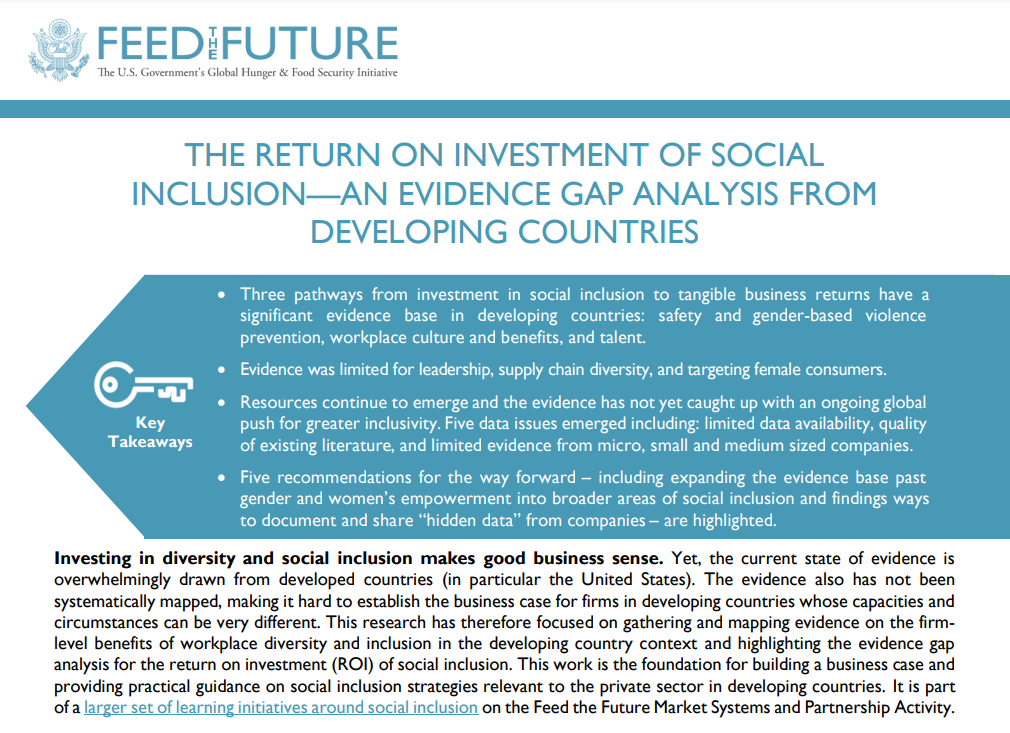
The Return on Investment of Social Inclusion: An Evidence Gap Analysis from Developing Countries
This research focuses on gathering and mapping evidence on the firm level benefits of workplace diversity and inclusion in the developing country context and highlighting the evidence gap analysis for the return on investment (ROI) of social inclusion. This work is the foundation for building a business case and providing practical guidance on social inclusion strategies relevant to the private sector in developing countries.
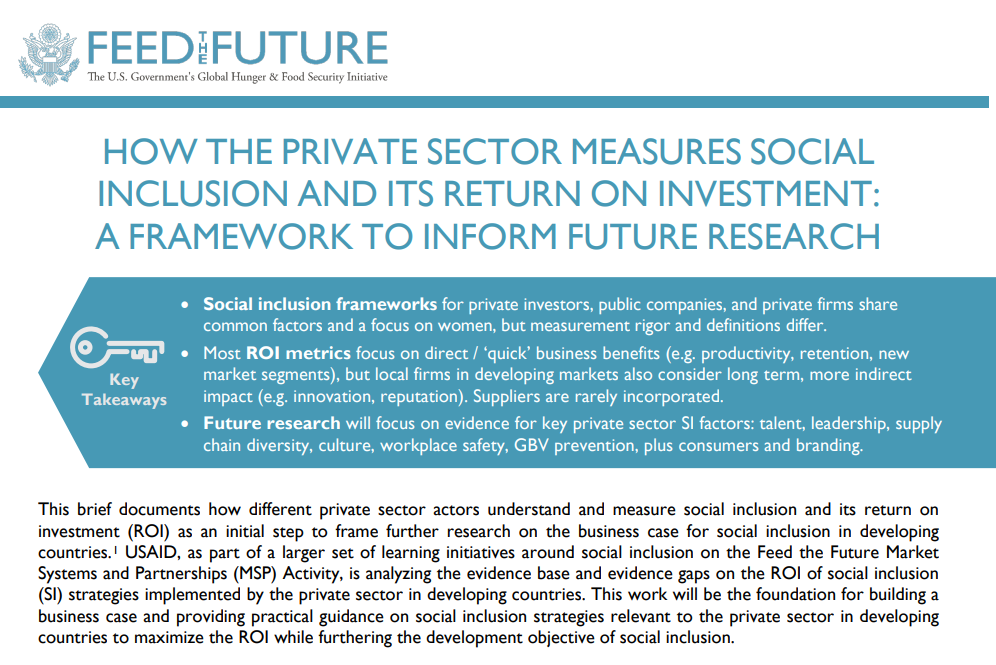
How the Private Sector Measures Social Inclusion and its Return on Investment: A Framework to Inform Future Research
This brief documents how different private sector actors understand and measure social inclusion and its return on investment (ROI) as an initial step to frame further research on the business case for social inclusion in developing countries. This work will be the foundation for building a business case and providing practical guidance on social inclusion strategies relevant to the private sector in developing countries to maximize the ROI while furthering the development objective of social inclusion.